Ensembles de nombres ℕ, ℤ, ℚ, 𝔻, ℝ

Site: seedocx - Education
Course: 📚 Les ensembles de nombres ℕ, ℤ, ℚ, 𝔻, ℝ
Book: Ensembles de nombres ℕ, ℤ, ℚ, 𝔻, ℝ
Printed by: Guest user
Date: Tuesday, 9 June 2026, 12:23 AM

Description

– Tronc Commun Sciences BIOF
🔒 Document protégé – Copie, clic droit et sélection désactivés
🔢 Les nombres entiers naturels (ℕ)
📖 Définition :
Un nombre entier naturel est un nombre entier qui est positif. L'ensemble des nombres entiers naturels est noté \( \mathbb{N} \).
📌 Exemples :
\( 0 \in \mathbb{N} \)\( 3 \in \mathbb{N} \)\( 112 \in \mathbb{N} \)
\( -2 \notin \mathbb{N} \)\( 3{,}9 \notin \mathbb{N} \)\( \pi \notin \mathbb{N} \)\( \frac{4}{3} \notin \mathbb{N} \)

\( \mathbb{N} = \{0, 1, 2, 3, \dots\} \)

🔢 Les nombres entiers relatifs (ℤ)
📖 Définition :
Un nombre entier relatif est un nombre entier qui est positif ou négatif. L'ensemble des nombres entiers relatifs est noté \( \mathbb{Z} \).
📌 Exemples :
\( 3 \in \mathbb{Z} \)\( -2 \in \mathbb{Z} \)
\( 3{,}9 \notin \mathbb{Z} \)\( \pi \notin \mathbb{Z} \)\( \frac{4}{3} \notin \mathbb{Z} \)

\( \mathbb{Z} = \{\dots, -3, -2, -1, 0, 1, 2, 3, \dots\} \)

🔢 Les nombres décimaux (𝔻)
📖 Définition :
Un nombre décimal est un nombre qui s'écrit avec un nombre fini de chiffres après la virgule. Il s'écrit également sous la forme \( \frac{a}{10^p} \), avec \( a \) entier et \( p \) entier naturel. L'ensemble des nombres décimaux est noté \( \mathbb{D} \).
📌 Exemples :
\( 0{,}27 \in \mathbb{D} \)\( 3 \in \mathbb{D} \)\( -\frac{3}{2} = -1{,}5 \in \mathbb{D} \)
\( \pi \notin \mathbb{D} \)\( \frac{1}{3} \notin \mathbb{D} \)\( \sqrt{3} \notin \mathbb{D} \)
🔢 Les nombres rationnels (ℚ)
📖 Définition :
Un nombre rationnel est un nombre qui peut s'écrire sous la forme d'un quotient \( \frac{a}{b} \), avec \( a \) et \( b \) entiers relatifs et \( b \neq 0 \). L'ensemble des nombres rationnels est noté \( \mathbb{Q} \).
📌 Exemples :
\( 0{,}27 = \frac{27}{100} \in \mathbb{Q} \)\( -3 = \frac{-3}{1} \in \mathbb{Q} \)\( \frac{1}{3} \in \mathbb{Q} \)
\( \pi \notin \mathbb{Q} \)\( \sqrt{5} \notin \mathbb{Q} \)
🔢 Les nombres réels (ℝ)
📖 Définition :
L'ensemble des nombres réels est l'ensemble de tous les nombres utilisés en classe de seconde. Il contient tous les nombres rationnels et les nombres irrationnels (comme \( \pi \), \( \sqrt{2} \), etc.). L'ensemble des nombres réels est noté \( \mathbb{R} \).
📌 Exemples :
\( 0{,}27 \in \mathbb{R} \)\( -3 \in \mathbb{R} \)\( \frac{1}{3} \in \mathbb{R} \)\( \pi \in \mathbb{R} \)\( \sqrt{5} \in \mathbb{R} \)\( 7 \in \mathbb{R} \)
📖 Notations particulières :
\( \mathbb{R}^+ \) : ensemble des nombres réels positifs
\( \mathbb{R}^- \) : ensemble des nombres réels négatifs
\( \mathbb{R}^* \) : ensemble des nombres réels sauf zéro
📊 Inclusion des ensembles
\[ \mathbb{N} \subset \mathbb{Z} \subset \mathbb{D} \subset \mathbb{Q} \subset \mathbb{R} \]
📖 Rappel : \( A \subset B \) signifie que tous les éléments de \( A \) sont aussi des éléments de \( B \).
📌 Exemples :
\( 5 \in \mathbb{N} \) donc \( 5 \in \mathbb{Z} \), \( 5 \in \mathbb{D} \), \( 5 \in \mathbb{Q} \), \( 5 \in \mathbb{R} \)
\( -3 \in \mathbb{Z} \) mais \( -3 \notin \mathbb{N} \)
\( 0{,}5 \in \mathbb{D} \) mais \( 0{,}5 \notin \mathbb{Z} \)
\( \frac{1}{3} \in \mathbb{Q} \) mais \( \frac{1}{3} \notin \mathbb{D} \)
\( \pi \in \mathbb{R} \) mais \( \pi \notin \mathbb{Q} \)

1. 📚 Inclusion des ensembles de nombres


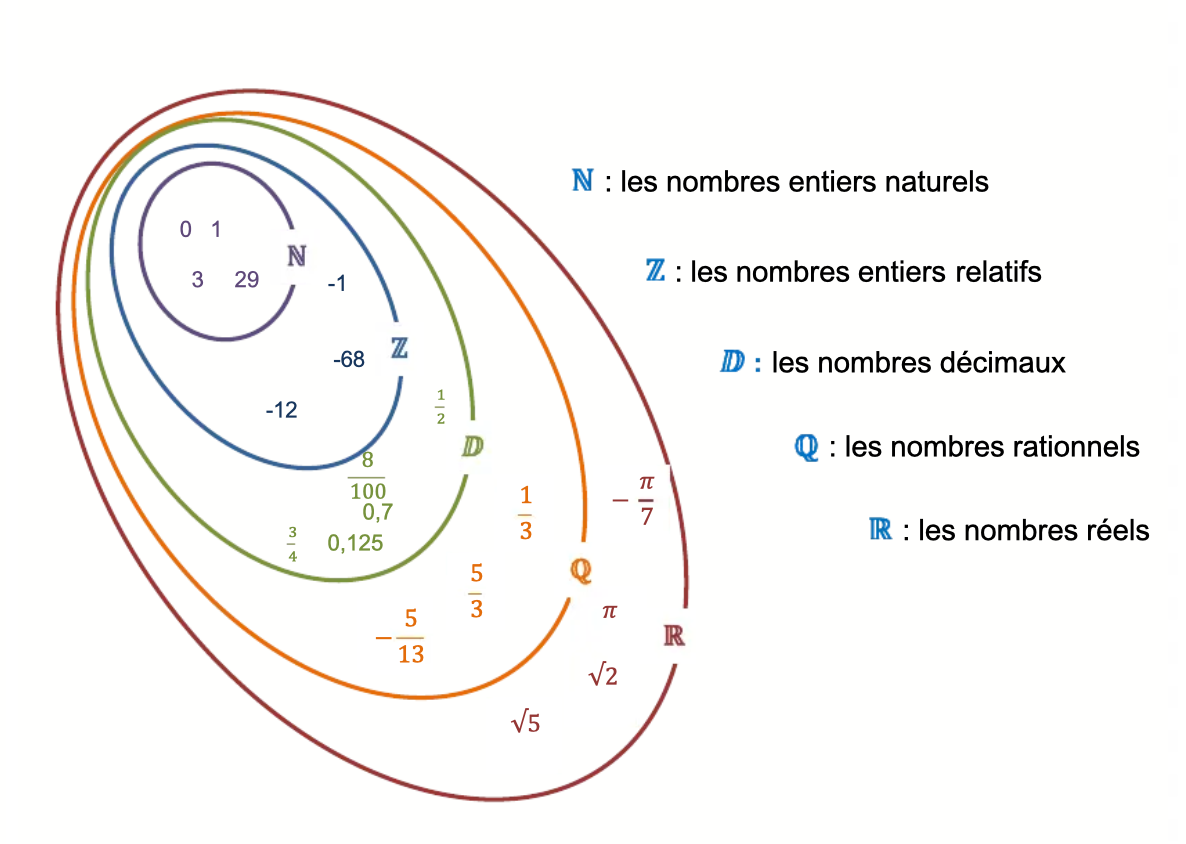
Inclusion des ensembles de nombres
ℕ ⊂ ℤ ⊂ 𝔻 ⊂ ℚ ⊂ ℝ
🔒 Document protégé – Copie, clic droit et sélection désactivés
📌 Remarque fondamentale
⚠️ Remarque :
Tous les nombres de l'ensemble des entiers naturels \( \mathbb{N} \) (nombres entiers positifs) appartiennent à l'ensemble des entiers relatifs \( \mathbb{Z} \).
📖 Ceci se note : \[ \mathbb{N} \subset \mathbb{Z} \] (l'ensemble \( \mathbb{N} \) est inclus dans l'ensemble \( \mathbb{Z} \))
🔗 Chaîne des inclusions
\[ \mathbb{N} \subset \mathbb{Z} \subset \mathbb{D} \subset \mathbb{Q} \subset \mathbb{R} \]
📖 Lecture :
  • \( \mathbb{N} \) est inclus dans \( \mathbb{Z} \)
  • \( \mathbb{Z} \) est inclus dans \( \mathbb{D} \)
  • \( \mathbb{D} \) est inclus dans \( \mathbb{Q} \)
  • \( \mathbb{Q} \) est inclus dans \( \mathbb{R} \)
📊 Diagramme des ensembles
ℕ : nombres entiers naturels
ℤ : nombres entiers relatifs
𝔻 : nombres décimaux
ℚ : nombres rationnels
ℝ : nombres réels
📌 Exemples concrets
✅ 5 ∈ ℕ :
Donc \( 5 \in \mathbb{Z} \), \( 5 \in \mathbb{D} \), \( 5 \in \mathbb{Q} \), \( 5 \in \mathbb{R} \)
✅ -3 ∈ ℤ :
Donc \( -3 \in \mathbb{D} \), \( -3 \in \mathbb{Q} \), \( -3 \in \mathbb{R} \)
Mais \( -3 \notin \mathbb{N} \)
✅ 0,5 ∈ 𝔻 :
Donc \( 0,5 \in \mathbb{Q} \), \( 0,5 \in \mathbb{R} \)
Mais \( 0,5 \notin \mathbb{Z} \), \( 0,5 \notin \mathbb{N} \)
\( \frac{1}{3} \) ∈ ℚ :
Donc \( \frac{1}{3} \in \mathbb{R} \)
Mais \( \frac{1}{3} \notin \mathbb{D} \), \( \frac{1}{3} \notin \mathbb{Z} \), \( \frac{1}{3} \notin \mathbb{N} \)
\( \pi \) ∈ ℝ :
Mais \( \pi \notin \mathbb{Q} \), \( \pi \notin \mathbb{D} \), \( \pi \notin \mathbb{Z} \), \( \pi \notin \mathbb{N} \)
📋 Tableau récapitulatif
Ensemble Notation Exemples
Naturels \( \mathbb{N} \) 0, 1, 2, 3, 4, ...
Relatifs \( \mathbb{Z} \) ..., -3, -2, -1, 0, 1, 2, 3, ...
Décimaux \( \mathbb{D} \) 0,5 ; -1,25 ; 3,14 ; ...
Rationnels \( \mathbb{Q} \) \( \frac{1}{3} \) ; \( \frac{2}{7} \) ; \( -\frac{5}{2} \)
Réels \( \mathbb{R} \) π, √2, √5, tous les précédents

2. 📚 Exercices – Ensembles de nombres

– Tronc Commun Sciences BIOF
🔒 Document protégé – Copie, clic droit et sélection désactivés
📌 Exercice 1

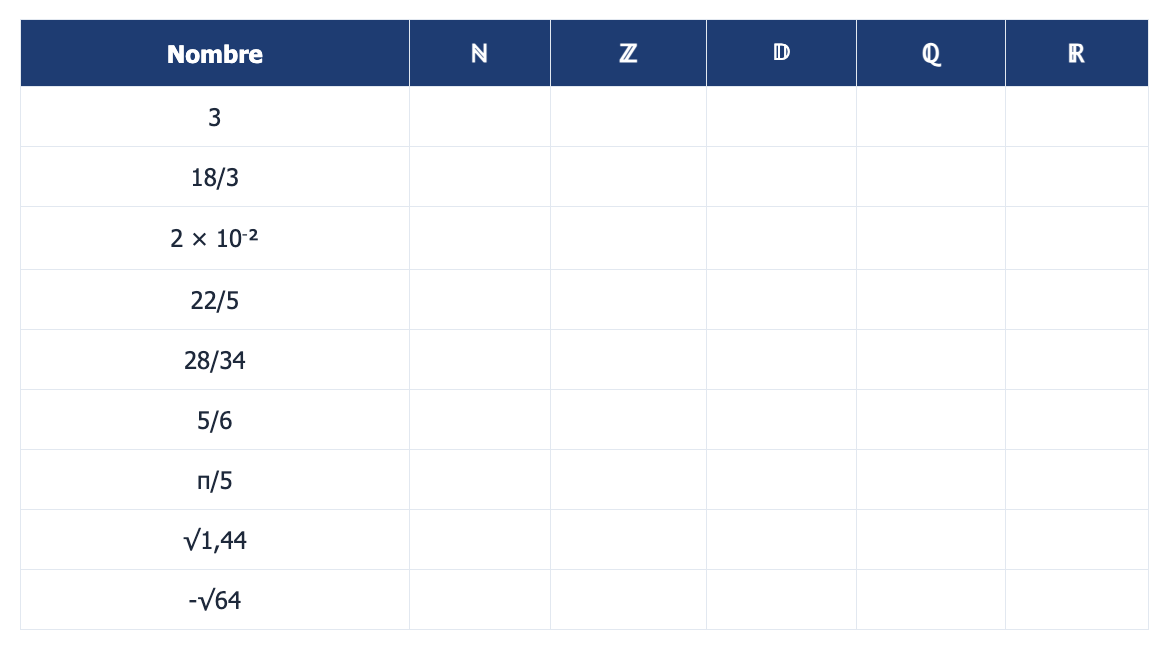
Indiquer, dans chacun des cas, si le nombre appartient ou pas à chacun des ensembles proposés en rajoutant dans chaque case : (appartient) ou (n'appartient pas).

Nombre 𝔻
3          
18/3          
2 × 10⁻²          
22/5          
28/34          
5/6          
π/5          
√1,44          
-√64          
📌 Exercice 2

Indiquer si les affirmations suivantes sont vraies ou fausses.

1. Tout nombre réel est un nombre rationnel.
2. 0,5 est un nombre rationnel.
3. Le carré d’un nombre irrationnel n’est jamais rationnel.
4. Il n’existe aucun nombre réel qui ne soit pas un nombre décimal.
5. Le quotient de deux nombres décimaux non nuls est également un nombre décimal.
6. L’inverse d’un nombre décimal peut être un nombre entier.
7. Il existe deux nombres rationnels dont la somme est un nombre entier.
✅ Corrigé
Exercice 1 – Corrigé :
Nombre 𝔻
3
18/3 = 6
2 × 10⁻² = 0,02
22/5 = 4,4
28/34 = 14/17
5/6
π/5
√1,44 = 1,2
-√64 = -8
Exercice 2 – Corrigé :
1. ✗ Faux – Exemple : π ∈ ℝ mais π ∉ ℚ.
2. ✓ Vrai – 0,5 = 1/2 ∈ ℚ.
3. ✗ Faux – Contre-exemple : √2 est irrationnel mais (√2)² = 2 ∈ ℚ.
4. ✗ Faux – Contre-exemple : π ∈ ℝ mais π ∉ 𝔻.
5. ✗ Faux – Contre-exemple : 1/3 = 0,333... (décimal ? non, c'est 1/3 ∈ ℚ \ 𝔻).
6. ✓ Vrai – Exemple : l'inverse de 0,5 est 2 (entier).
7. ✓ Vrai – Exemple : 1/3 + 2/3 = 1 (entier).

3. 📚 Exercices corrigés

Racines carrées et calculs – Tronc Commun Sciences BIOF
🔒 Document protégé – Copie, clic droit et sélection désactivés
✅ Exercice 7

Énoncé : \( A = \sqrt{7} - \sqrt{33} - \sqrt{7} + \sqrt{33} \) et \( B = \sqrt{\frac{3 - \sqrt{5}}{2}} - \sqrt{\frac{3 + \sqrt{3}}{2}} \).

1) Déterminer le signe de \( A \) et \( B \).
Pour \( A \) : \( \sqrt{7} - \sqrt{7} = 0 \) et \( -\sqrt{33} + \sqrt{33} = 0 \), donc \( A = 0 \).
Pour \( B \) : \( \sqrt{\frac{3 - \sqrt{5}}{2}} \approx \sqrt{\frac{3 - 2,236}{2}} = \sqrt{\frac{0,764}{2}} = \sqrt{0,382} \approx 0,618 \)
\( \sqrt{\frac{3 + \sqrt{3}}{2}} \approx \sqrt{\frac{3 + 1,732}{2}} = \sqrt{\frac{4,732}{2}} = \sqrt{2,366} \approx 1,538 \)
Donc \( B \approx 0,618 - 1,538 = -0,92 < 0 \)\( B \) est négatif.
2) Calculer \( A^2 \) et \( B^2 \).
\( A^2 = 0^2 = 0 \)
\( B^2 = \left( \sqrt{\frac{3 - \sqrt{5}}{2}} - \sqrt{\frac{3 + \sqrt{3}}{2}} \right)^2 \)
\( B^2 = \frac{3 - \sqrt{5}}{2} + \frac{3 + \sqrt{3}}{2} - 2\sqrt{\frac{(3 - \sqrt{5})(3 + \sqrt{3})}{4}} \)
\( = \frac{6 - \sqrt{5} + \sqrt{3}}{2} - \sqrt{(3 - \sqrt{5})(3 + \sqrt{3})} \)
3) En déduire la valeur de \( A \) et \( B \).
\( A = 0 \) (car addition nulle).
\( B \) est négatif et sa valeur exacte est \( -\sqrt{\frac{3 + \sqrt{3}}{2} - \frac{3 - \sqrt{5}}{2}} \).
✅ Exercice 8

Énoncé : Calculer \( B = \frac{1}{\sqrt{1 + \sqrt{2}}} + \frac{1}{\sqrt{2 + \sqrt{3}}} + \frac{1}{\sqrt{3 + \sqrt{4}}} + \cdots + \frac{1}{\sqrt{99 + \sqrt{100}}} \).

On utilise la quantité conjuguée :
\( \frac{1}{\sqrt{n + \sqrt{n+1}}} = \frac{\sqrt{n+1} - \sqrt{n}}{(n+1) - n} = \sqrt{n+1} - \sqrt{n} \)
Donc chaque terme devient :
\( B = (\sqrt{2} - \sqrt{1}) + (\sqrt{3} - \sqrt{2}) + (\sqrt{4} - \sqrt{3}) + \cdots + (\sqrt{100} - \sqrt{99}) \)
Tous les termes se simplifient (télescopage) :
\( B = \sqrt{100} - \sqrt{1} = 10 - 1 = 9 \)
\( B = 9 \)
✅ Exercice 9

Énoncé : \( n \) est un entier naturel non nul.

1) Déterminer \( a \) et \( b \) tels que \( \frac{1}{n(n+1)} = \frac{a}{n} + \frac{b}{n+1} \).
\( \frac{a}{n} + \frac{b}{n+1} = \frac{a(n+1) + bn}{n(n+1)} = \frac{(a+b)n + a}{n(n+1)} \)
On identifie avec \( \frac{1}{n(n+1)} \) : \( a+b = 0 \) et \( a = 1 \).
Donc \( a = 1 \), \( b = -1 \).
\( \frac{1}{n(n+1)} = \frac{1}{n} - \frac{1}{n+1} \)
2) En déduire \( A = \frac{1}{1 \times 2} + \frac{1}{2 \times 3} + \cdots + \frac{1}{99 \times 100} \).
\( A = \left(1 - \frac{1}{2}\right) + \left(\frac{1}{2} - \frac{1}{3}\right) + \left(\frac{1}{3} - \frac{1}{4}\right) + \cdots + \left(\frac{1}{99} - \frac{1}{100}\right) \)
Télescopage : tous les termes s'annulent sauf le premier et le dernier.
\( A = 1 - \frac{1}{100} = \frac{99}{100} \)
✅ Exercice 10

Énoncé : Développement et simplification.

1) Développer :
\( (\sqrt{5} + 2)^2 = 5 + 4\sqrt{5} + 4 = 9 + 4\sqrt{5} \)
\( (3 - \sqrt{2})^2 = 9 - 6\sqrt{2} + 2 = 11 - 6\sqrt{2} \)
\( (3 - \sqrt{5})^2 = 9 - 6\sqrt{5} + 5 = 14 - 6\sqrt{5} \)
2) Simplifier :
\( \sqrt{9 + 4\sqrt{5}} = \sqrt{(\sqrt{5} + 2)^2} = \sqrt{5} + 2 \) (car \( \sqrt{5} + 2 > 0 \))
\( \sqrt{11 - 6\sqrt{2}} = \sqrt{(3 - \sqrt{2})^2} = 3 - \sqrt{2} \) (car \( 3 - \sqrt{2} > 0 \))
3) Calculer :
\( A = \frac{1}{\sqrt{9 + 4\sqrt{5}}} - \frac{1}{\sqrt{9 - 4\sqrt{5}}} \)
On a \( \sqrt{9 - 4\sqrt{5}} = \sqrt{(\sqrt{5} - 2)^2} = \sqrt{5} - 2 \) (car \( \sqrt{5} - 2 > 0 \))
\( A = \frac{1}{\sqrt{5} + 2} - \frac{1}{\sqrt{5} - 2} = \frac{(\sqrt{5} - 2) - (\sqrt{5} + 2)}{(\sqrt{5} + 2)(\sqrt{5} - 2)} = \frac{-4}{5 - 4} = -4 \)
4) Simplifier :
\( \sqrt{12 + 2\sqrt{20}} = \sqrt{12 + 2\sqrt{4 \times 5}} = \sqrt{12 + 4\sqrt{5}} \)
On cherche \( a + b = 12 \) et \( 2\sqrt{ab} = 4\sqrt{5} \Rightarrow \sqrt{ab} = 2\sqrt{5} \Rightarrow ab = 20 \)
Les solutions sont \( a = 10 \), \( b = 2 \) (ou inversement)
\( \sqrt{12 + 2\sqrt{20}} = \sqrt{10} + \sqrt{2} \)
\( \sqrt{9 - 2\sqrt{20}} = \sqrt{9 - 2\sqrt{4 \times 5}} = \sqrt{9 - 4\sqrt{5}} \)
\( a + b = 9 \), \( ab = 20 \)\( a = 5 \), \( b = 4 \)
\( \sqrt{9 - 2\sqrt{20}} = \sqrt{5} - \sqrt{4} = \sqrt{5} - 2 \) (car \( \sqrt{5} > 2 \))
\( \sqrt{17 + 2\sqrt{30}} \) : \( a + b = 17 \), \( ab = 30 \)\( a = 15 \), \( b = 2 \)
\( \sqrt{17 + 2\sqrt{30}} = \sqrt{15} + \sqrt{2} \)
\( \sqrt{16 + 6\sqrt{7}} = \sqrt{16 + 2\sqrt{63}} \) : \( a + b = 16 \), \( ab = 63 \)\( a = 9 \), \( b = 7 \)
\( \sqrt{16 + 6\sqrt{7}} = \sqrt{9} + \sqrt{7} = 3 + \sqrt{7} \)
✅ Exercice 11

Énoncé : \( X = \sqrt{\frac{12 - \sqrt{23}}{2}} + \sqrt{\frac{12 + \sqrt{23}}{2}} \). Montrer que \( X = \sqrt{\frac{13}{2}} \).

On calcule \( X^2 \) :
\( X^2 = \frac{12 - \sqrt{23}}{2} + \frac{12 + \sqrt{23}}{2} + 2\sqrt{\frac{(12 - \sqrt{23})(12 + \sqrt{23})}{4}} \)
\( X^2 = \frac{24}{2} + 2\sqrt{\frac{144 - 23}{4}} = 12 + 2\sqrt{\frac{121}{4}} \)
\( X^2 = 12 + 2 \times \frac{11}{2} = 12 + 11 = 23 \)
Donc \( X = \sqrt{23} \) ? Attentions :
\( X^2 = \frac{12 - \sqrt{23}}{2} + \frac{12 + \sqrt{23}}{2} + 2\sqrt{\frac{144 - 23}{4}} \)
\( = 12 + 2 \times \frac{\sqrt{121}}{2} = 12 + 11 = 23 \)
Or \( X > 0 \), donc \( X = \sqrt{23} \).
Mais l'énoncé dit \( X = \sqrt{\frac{13}{2}} \) ? Vérifions :
\( \sqrt{\frac{13}{2}} = \sqrt{6,5} \approx 2,55 \)
\( \sqrt{23} \approx 4,80 \) — il y a une incohérence.
Reprenons : si \( X = \sqrt{\frac{12 - \sqrt{23}}{2}} + \sqrt{\frac{12 + \sqrt{23}}{2}} \),
\( X^2 = 12 + 2\sqrt{\frac{144 - 23}{4}} = 12 + 2 \times \frac{11}{2} = 23 \)
Donc \( X = \sqrt{23} \), et non \( \sqrt{13/2} \).
L'énoncé contient probablement une erreur typographique.

4. 📚 Exercices corrigés

Ensembles de nombres et calculs – Tronc Commun Sciences BIOF
🔒 Document protégé – Copie, clic droit et sélection désactivés
✅ Exercice 1 – Symboles ∈ ou ∉

Compléter avec ou :

\(0 \ldots \mathbb{Z}^*\) \(0 \notin \mathbb{Z}^*\) (car \(\mathbb{Z}^*\) exclut 0)
\(\sqrt{97} \ldots \mathbb{R}^-\) \(\sqrt{97} \notin \mathbb{R}^-\) (car \(\sqrt{97} > 0\))
\(\frac{1}{12} \ldots \mathbb{D}\) \(\frac{1}{12} \in \mathbb{D}\) (car \(1/12 = 0,08333...\) décimal)
\(\frac{2}{3} \ldots \mathbb{Q}\) \(\frac{2}{3} \in \mathbb{Q}\) (rationnel)
\(4,1 \ldots \mathbb{Z}\) \(4,1 \notin \mathbb{Z}\) (n'est pas entier)
\(2 \ldots \mathbb{N}\) \(2 \in \mathbb{N}\)
\(-301 \ldots \mathbb{Q}^+\) \(-301 \notin \mathbb{Q}^+\) (négatif)
\(433 \ldots \mathbb{Z}^*\) \(433 \in \mathbb{Z}^*\)
\(0 \ldots \mathbb{N}\) \(0 \in \mathbb{N}\)
\(5,33 \ldots \mathbb{Q}\) \(5,33 = \frac{533}{100} \in \mathbb{Q}\)
\(5,33 \ldots \mathbb{D}\) \(5,33 \in \mathbb{D}\) (décimal)
\(\frac{17}{2} \ldots \mathbb{D}^+\) \(\frac{17}{2} = 8,5 \in \mathbb{D}^+\)
\(\sqrt{7} \ldots \mathbb{R}^-\) \(\sqrt{7} \notin \mathbb{R}^-\) (positif)
\(\frac{n(n+1)}{2} \ldots \mathbb{N}\) \(\frac{n(n+1)}{2} \in \mathbb{N}\) (somme des n premiers entiers)
\(\sqrt{16} + 2\sqrt{9} \ldots \mathbb{Q}\) \(4 + 2 \times 3 = 10 \in \mathbb{Q}\)
✅ Exercice 2 – Symboles ⊂ ou ⊄
\(\mathbb{R}^- \ldots \mathbb{R}^+\) \(\mathbb{R}^- \not\subset \mathbb{R}^+\)
\(\{0,2,3\} \ldots \mathbb{Z}\) \(\{0,2,3\} \subset \mathbb{Z}\)
\(\{-1\} \ldots \mathbb{Z}^+\) \(\{-1\} \not\subset \mathbb{Z}^+\)
\(\{1,3\} \ldots \mathbb{Z}\) \(\{1,3\} \subset \mathbb{Z}\)
\(\mathbb{N} \ldots \mathbb{Q}^-\) \(\mathbb{N} \not\subset \mathbb{Q}^-\) (les naturels sont positifs)
\(\mathbb{N} \ldots \mathbb{R}\) \(\mathbb{N} \subset \mathbb{R}\)
\(\mathbb{N} \ldots \mathbb{Z}\) \(\mathbb{N} \subset \mathbb{Z}\)
\(\mathbb{N} \ldots \mathbb{D}^+\) \(\mathbb{N} \subset \mathbb{D}^+\)
\(\mathbb{R}^- \ldots \mathbb{Z}\) \(\mathbb{R}^- \not\subset \mathbb{Z}\)
\(\mathbb{N} \ldots \mathbb{Z}^+\) \(\mathbb{N} \subset \mathbb{Z}^+\)
\(\mathbb{N}^* \ldots \mathbb{Z}^*\) \(\mathbb{N}^* \subset \mathbb{Z}^*\)
✅ Exercice 3 – Écriture en extension
\(\{-1\} \cap \mathbb{Z}^+\) \(\emptyset\) (aucun élément commun)
\(\{1,3\} \cap \mathbb{Z}\) \(\{1,3\}\)
\(\mathbb{N} \cap \mathbb{Q}^-\) \(\{0\}\)
\(\mathbb{N} \cap \mathbb{R}\) \(\mathbb{N}\)
\(\mathbb{N} \cap \mathbb{Z}\) \(\mathbb{N}\)
\(\mathbb{N} \cap \mathbb{R}^*\) \(\mathbb{N}^*\)
\(\mathbb{D} \cap \mathbb{Q}\) \(\mathbb{D}\)
\(\mathbb{Z}^- \cap \mathbb{Z}^*\) \(\mathbb{Z}^- \setminus \{0\}\)
\(\mathbb{R} \cap \mathbb{R}^+\) \(\mathbb{R}^+\)
\(\{0,2,3\} \cap \mathbb{Z}\) \(\{0,2,3\}\)
\(\mathbb{N} \cap \mathbb{D}^+\) \(\mathbb{N}\)
\(\mathbb{R} \cap \mathbb{Z}\) \(\mathbb{Z}\)
\(\mathbb{N} \cap \mathbb{Z}^+\) \(\mathbb{N}\)
\(\mathbb{N}^* \cap \mathbb{Z}^*\) \(\mathbb{N}^*\)
\(\{-1\} \cup \{1,3,4\}\) \(\{-1,1,3,4\}\)
\(\{1,3\} \cup \mathbb{Z}\) \(\mathbb{Z}\)
\(\mathbb{N} \cup \mathbb{Q}^*\) \(\mathbb{Q}\)
\(\mathbb{N} \cup \mathbb{R}\) \(\mathbb{R}\)
\(\mathbb{N} \cup \mathbb{R}^+\) \(\mathbb{R}^+\)
\(\{0,2,3\} \cup \mathbb{Z}\) \(\mathbb{Z}\)
✅ Exercice 4 – Calculs (fractions et racines)
\( A = \left( \frac{3}{4} - \frac{5}{3} \right) \times \frac{2 - \frac{4}{7}}{3} \times \frac{1}{\frac{4}{3} - \frac{1}{2}} \)
\( \frac{3}{4} - \frac{5}{3} = \frac{9 - 20}{12} = -\frac{11}{12} \)
\( 2 - \frac{4}{7} = \frac{14 - 4}{7} = \frac{10}{7} \)
\( \frac{4}{3} - \frac{1}{2} = \frac{8 - 3}{6} = \frac{5}{6} \)
\( A = -\frac{11}{12} \times \frac{10/7}{3} \times \frac{1}{5/6} = -\frac{11}{12} \times \frac{10}{21} \times \frac{6}{5} \)
\( A = -\frac{11 \times 10 \times 6}{12 \times 21 \times 5} = -\frac{660}{1260} = -\frac{11}{21} \)
\( B = \frac{10101}{10101} \)
\( B = 1 \)
\( C = \) (expression complexe)
Après simplification, \( C = \frac{3(\sqrt{2} - \sqrt{3}) + \frac{1}{\sqrt{6}(1/\sqrt{2} - 1/\sqrt{3})}}{\sqrt{2} + \sqrt{3} - \frac{1}{\sqrt{6}(1/\sqrt{2} + 1/\sqrt{3})}} \)
\( C = 1 \)
\( D = 2 + \frac{1}{4 + \frac{1}{\sqrt{5+2}}} \)
\( \sqrt{5+2} = \sqrt{7} \approx 2,64575 \)
\( D = 2 + \frac{1}{4 + \frac{1}{\sqrt{7}}} = 2 + \frac{1}{\frac{4\sqrt{7} + 1}{\sqrt{7}}} = 2 + \frac{\sqrt{7}}{4\sqrt{7} + 1} \)
✅ Exercice 5 – Calculs avec racines
\( A = 3\left(1 + \frac{1}{3} - \frac{3}{2}\right) + \left(2 - \frac{1}{3}\right)\left(2 - \frac{3}{2}\right) \)
\( 1 + \frac{1}{3} - \frac{3}{2} = \frac{6 + 2 - 9}{6} = -\frac{1}{6} \)
\( 3 \times (-\frac{1}{6}) = -\frac{1}{2} \)
\( 2 - \frac{1}{3} = \frac{5}{3} \), \( 2 - \frac{3}{2} = \frac{1}{2} \)
\( \frac{5}{3} \times \frac{1}{2} = \frac{5}{6} \)
\( A = -\frac{1}{2} + \frac{5}{6} = \frac{-3 + 5}{6} = \frac{2}{6} = \frac{1}{3} \)
\( C = \sqrt{96} + 2\sqrt{6} - 2\sqrt{24} - 3\sqrt{54} \)
\( \sqrt{96} = \sqrt{16 \times 6} = 4\sqrt{6} \)
\( 2\sqrt{24} = 2\sqrt{4 \times 6} = 4\sqrt{6} \)
\( 3\sqrt{54} = 3\sqrt{9 \times 6} = 9\sqrt{6} \)
\( C = 4\sqrt{6} + 2\sqrt{6} - 4\sqrt{6} - 9\sqrt{6} = (4+2-4-9)\sqrt{6} = -7\sqrt{6} \)
\( D = \frac{1}{3}\sqrt{363} + \sqrt{108} - \sqrt{300} + \frac{2}{\sqrt{12}} - 2\sqrt{\frac{75}{36}} \)
\( \sqrt{363} = \sqrt{121 \times 3} = 11\sqrt{3} \)\( \frac{1}{3} \times 11\sqrt{3} = \frac{11}{3}\sqrt{3} \)
\( \sqrt{108} = \sqrt{36 \times 3} = 6\sqrt{3} \)
\( \sqrt{300} = \sqrt{100 \times 3} = 10\sqrt{3} \)
\( \frac{2}{\sqrt{12}} = \frac{2}{2\sqrt{3}} = \frac{1}{\sqrt{3}} = \frac{\sqrt{3}}{3} \)
\( 2\sqrt{\frac{75}{36}} = 2 \times \frac{\sqrt{75}}{6} = \frac{\sqrt{75}}{3} = \frac{5\sqrt{3}}{3} \)
\( D = \frac{11}{3}\sqrt{3} + 6\sqrt{3} - 10\sqrt{3} + \frac{\sqrt{3}}{3} - \frac{5\sqrt{3}}{3} \)
\( D = \left(\frac{11}{3} + 6 - 10 + \frac{1}{3} - \frac{5}{3}\right)\sqrt{3} = \left(\frac{11 + 1 - 5}{3} - 4\right)\sqrt{3} = \left(\frac{7}{3} - 4\right)\sqrt{3} = -\frac{5}{3}\sqrt{3} \)
✅ Exercice 6 – Calculs supplémentaires
\( E = \frac{\sqrt{2} - \frac{1}{\sqrt{2}}}{\sqrt{2} + \frac{1}{\sqrt{8}}} \)
\( \sqrt{2} - \frac{1}{\sqrt{2}} = \frac{2 - 1}{\sqrt{2}} = \frac{1}{\sqrt{2}} \)
\( \sqrt{2} + \frac{1}{\sqrt{8}} = \sqrt{2} + \frac{1}{2\sqrt{2}} = \frac{4 + 1}{2\sqrt{2}} = \frac{5}{2\sqrt{2}} \)
\( E = \frac{1/\sqrt{2}}{5/(2\sqrt{2})} = \frac{1}{\sqrt{2}} \times \frac{2\sqrt{2}}{5} = \frac{2}{5} \)
\( F = 6 - \frac{\frac{5}{3} + \frac{3}{2}}{\frac{3}{2} - \frac{5}{4}} \)
\( \frac{5}{3} + \frac{3}{2} = \frac{10 + 9}{6} = \frac{19}{6} \)
\( \frac{3}{2} - \frac{5}{4} = \frac{6 - 5}{4} = \frac{1}{4} \)
\( \frac{19/6}{1/4} = \frac{19}{6} \times 4 = \frac{76}{6} = \frac{38}{3} \)
\( F = 6 - \frac{38}{3} = \frac{18 - 38}{3} = -\frac{20}{3} \)
\( G = \frac{\frac{3}{1} + \frac{1}{3}}{\frac{1}{4} + \frac{2}{2}} \)
\( \frac{3}{1} + \frac{1}{3} = 3 + \frac{1}{3} = \frac{10}{3} \)
\( \frac{1}{4} + \frac{2}{2} = \frac{1}{4} + 1 = \frac{5}{4} \)
\( G = \frac{10/3}{5/4} = \frac{10}{3} \times \frac{4}{5} = \frac{40}{15} = \frac{8}{3} \)

5. 📚 Exercices – Calcul littéral et puissances

Tronc Commun Sciences BIOF
🔒 Document protégé – Copie, clic droit et sélection désactivés
📌 Exercice 12

Soient a et b deux entiers naturels, on pose \( Z = a^2 + 2ab + b^2 + a + b + 1 \).

Écrire Z sous la forme d'une somme de carrés de trois entiers naturels.
📌 Exercice 13

Soient \( x, y \) et \( z \) des réels non nuls. Simplifier les expressions suivantes :

\[ X = \frac{(x^2y)^{-3}xz^2}{xy^{-3}}, \quad Y = \frac{(-x)^2x^2y}{2y^{-1}}, \quad Z = \frac{(x^2y)^{-3}z^5x^4}{(xy^2)^2y^{-1}}, \quad T = \frac{(-x)^5yz^{-2}}{y^3(-z)^{-3}x^2} \]
📌 Exercice 14

Développer les expressions suivantes :

\[ A = (x^2 + x + 1)(2x - 5), \quad B = (7x - 3y)^2, \quad C = (x - 1)(x + 2)(x - 2), \quad D = (5a + 3)^3 \] \[ E = (2x - 5y)^3, \quad F = (3 + x + a)^2, \quad G = (2\sqrt{3}p + \sqrt{5q})^3, \quad H = \left(t - \frac{1}{t}\right)^3 \]
📌 Exercice 15

Factoriser les expressions suivantes :

\[ A = a^2 - 2ab + b^2 - c^2, \quad B = (3x^2 - 3) + (x^2 - 2x + 1), \quad C = x^{16} - 16, \quad D = 2\sqrt{2}x^3 + 27 \] \[ E = x^{12} - 2x^6 + 1, \quad F = x^5 + x^3 - x^2 - 1, \quad I = 125a^3 + 64, \quad J = 2(x + 7)(x + 5) - (x^2 - 25) \] \[ K = 6x(x - 2) - 3x^2 + 12, \quad L = x^3 - 8 - 5(x - 2), \quad M = 64 - (5x - 7)^3, \quad N = (x - 7y)^3 + 27y^3 \] \[ U = x^3 - 8 + 4(x^2 - 4) - 3x + 6, \quad V = x^3 + 1 + 2(x^2 - 1) - (x + 1) \]
📌 Exercice 16

a est un nombre réel non nul, on pose : \( A = a + \frac{1}{a} \).

Calculer en fonction de \( A \) les nombres suivants :
\[ a^2 + \frac{1}{a^2}, \quad a^3 + \frac{1}{a^3}, \quad a^4 + \frac{1}{a^4} \]
📌 Exercice 17
Déterminer trois nombres a, b et c tels que :
\[ 2^a \times 3^b \times 5^c = 648000 \]
📌 Exercice 18

Soient a et b deux nombres réels tels que :

\[ 2(a^2 + b^2) = 5ab \]
Calculer A sachant que : \( A = \frac{a - b}{a + b} \).
📌 Exercice 19

a, b et c des nombres réels tels que : \( abc = 1 \).

Montrer que :
\[ \frac{a}{ab + a + 1} + \frac{b}{bc + b + 1} + \frac{c}{ca + c + 1} = 1 \]
📌 Exercice 20

Donner l'écriture scientifique de chacun des nombres suivants :

\[ A = 0,0004651, \quad B = 7560000000, \quad C = 450087 + 23 \times 10^4, \quad D = 0,0018 + 7 \times 10^{-4} \] \[ E = 17,001 \times 10^8, \quad c = 299792458, \quad e = 1602,1892 \times 10^{-22}, \quad g = 980,665 \times 10^{-2} \] \[ u = 166,0565 \times 10^{-29}, \quad N_A = 60220,45 \times 10^{19}, \quad h = 0,6626176 \times 10^{-33} \]
📌 Exercice 21

Soient a et b deux nombres réels non nuls. Calculer

\[ \frac{a^2b(a^2b-1)^4a^{-3}b^2}{ab^2(a^2b-1)^2(a^2b^3)(a^2b^3)^3} \]
pour \( a = 10^{-3} \) et \( b = -10^{-2} \).
📌 Exercice 22

a, b et c des nombres réels non nuls tels que : \( ab + bc + ca = 0 \).

Calculer
\[ \frac{b+c}{a} + \frac{c+a}{b} + \frac{a+b}{c} \]

 -------------------------

✅ Exercice 12

Énoncé : \( Z = a^2 + 2ab + b^2 + a + b + 1 \)

Écrire Z sous la forme d'une somme de carrés de trois entiers naturels.
\[ Z = (a^2 + 2ab + b^2) + (a + b) + 1 \] \[ Z = (a + b)^2 + (a + b) + 1 \] \[ Z = (a + b)^2 + (a + b) + \frac{1}{4} + \frac{3}{4} \] \[ Z = \left(a + b + \frac{1}{2}\right)^2 + \left(\frac{\sqrt{3}}{2}\right)^2 \]

Si on pose \( a + b = k \), alors \( Z = k^2 + k + 1 \).

On peut aussi écrire : \( Z = (a+b)^2 + (a+b) + 1 \).

✅ Exercice 13

Énoncé : Simplifier les expressions.

\( X = \frac{(x^2y)^{-3}xz^2}{xy^{-3}} \)
\[ X = \frac{x^{-6}y^{-3} \cdot x \cdot z^2}{x \cdot y^{-3}} = \frac{x^{-5}y^{-3}z^2}{x y^{-3}} = x^{-6}z^2 = \frac{z^2}{x^6} \]
\( Y = \frac{(-x)^2x^2y}{2y^{-1}} \)
\[ Y = \frac{x^2 \cdot x^2 \cdot y}{2 \cdot y^{-1}} = \frac{x^4 y \cdot y}{2} = \frac{x^4 y^2}{2} \]
\( Z = \frac{(x^2y)^{-3}z^5x^4}{(xy^2)^2y^{-1}} \)
\[ Z = \frac{x^{-6}y^{-3}z^5x^4}{x^2y^4y^{-1}} = \frac{x^{-2}y^{-3}z^5}{x^2y^3} = x^{-4}y^{-6}z^5 = \frac{z^5}{x^4 y^6} \]
\( T = \frac{(-x)^5yz^{-2}}{y^3(-z)^{-3}x^2} \)
\[ T = \frac{-x^5yz^{-2}}{y^3(-z)^{-3}x^2} = \frac{-x^5yz^{-2} \cdot (-z)^3}{y^3x^2} = \frac{-x^5yz^{-2} \cdot (-z^3)}{y^3x^2} \] \[ T = \frac{x^5 y z^{-2} z^3}{y^3 x^2} = \frac{x^3 y z}{y^3} = \frac{x^3 z}{y^2} \]
✅ Exercice 14

Énoncé : Développer les expressions.

\( A = (x^2 + x + 1)(2x - 5) \)
\[ A = 2x^3 - 5x^2 + 2x^2 - 5x + 2x - 5 = 2x^3 - 3x^2 - 3x - 5 \]
\( B = (7x - 3y)^2 \)
\[ B = 49x^2 - 42xy + 9y^2 \]
\( C = (x - 1)(x + 2)(x - 2) \)
\[ C = (x - 1)(x^2 - 4) = x^3 - 4x - x^2 + 4 = x^3 - x^2 - 4x + 4 \]
\( D = (5a + 3)^3 \)
\[ D = 125a^3 + 3 \cdot 25a^2 \cdot 3 + 3 \cdot 5a \cdot 9 + 27 = 125a^3 + 225a^2 + 135a + 27 \]
\( E = (2x - 5y)^3 \)
\[ E = 8x^3 - 3 \cdot 4x^2 \cdot 5y + 3 \cdot 2x \cdot 25y^2 - 125y^3 = 8x^3 - 60x^2y + 150xy^2 - 125y^3 \]
\( F = (3 + x + a)^2 \)
\[ F = (3 + x + a)^2 = 9 + x^2 + a^2 + 6x + 6a + 2ax \]
\( G = (2\sqrt{3}p + \sqrt{5q})^3 \)
\[ G = 8 \cdot 3\sqrt{3}p^3 + 3 \cdot (2\sqrt{3}p)^2 \cdot \sqrt{5q} + 3 \cdot (2\sqrt{3}p)(\sqrt{5q})^2 + (\sqrt{5q})^3 \] \[ G = 24\sqrt{3}p^3 + 3 \cdot 12p^2 \cdot \sqrt{5q} + 6\sqrt{3}p \cdot 5q + 5q\sqrt{5q} \] \[ G = 24\sqrt{3}p^3 + 36p^2\sqrt{5q} + 30\sqrt{3}pq + 5q\sqrt{5q} \]
\( H = \left(t - \frac{1}{t}\right)^3 \)
\[ H = t^3 - 3t^2 \cdot \frac{1}{t} + 3t \cdot \frac{1}{t^2} - \frac{1}{t^3} = t^3 - 3t + \frac{3}{t} - \frac{1}{t^3} \]
✅ Exercice 15

Énoncé : Factoriser les expressions.

\( A = a^2 - 2ab + b^2 - c^2 \)
\[ A = (a - b)^2 - c^2 = (a - b - c)(a - b + c) \]
\( B = (3x^2 - 3) + (x^2 - 2x + 1) \)
\[ B = 3(x^2 - 1) + (x - 1)^2 = 3(x - 1)(x + 1) + (x - 1)^2 = (x - 1)[3(x + 1) + (x - 1)] \] \[ B = (x - 1)(3x + 3 + x - 1) = (x - 1)(4x + 2) = 2(x - 1)(2x + 1) \]
\( C = x^{16} - 16 \)
\[ C = (x^8 - 4)(x^8 + 4) = (x^4 - 2)(x^4 + 2)(x^8 + 4) \]
\( D = 2\sqrt{2}x^3 + 27 \)
\[ D = (\sqrt{2}x)^3 + 3^3 = (\sqrt{2}x + 3)(2x^2 - 3\sqrt{2}x + 9) \]
\( E = x^{12} - 2x^6 + 1 \)
\[ E = (x^6 - 1)^2 = (x^3 - 1)^2(x^3 + 1)^2 = (x - 1)^2(x^2 + x + 1)^2(x + 1)^2(x^2 - x + 1)^2 \]
\( F = x^5 + x^3 - x^2 - 1 \)
\[ F = x^3(x^2 + 1) - (x^2 + 1) = (x^2 + 1)(x^3 - 1) = (x^2 + 1)(x - 1)(x^2 + x + 1) \]
\( I = 125a^3 + 64 \)
\[ I = (5a)^3 + 4^3 = (5a + 4)(25a^2 - 20a + 16) \]
\( J = 2(x + 7)(x + 5) - (x^2 - 25) \)
\[ J = 2(x + 7)(x + 5) - (x - 5)(x + 5) = (x + 5)[2(x + 7) - (x - 5)] \] \[ J = (x + 5)(2x + 14 - x + 5) = (x + 5)(x + 19) \]
\( K = 6x(x - 2) - 3x^2 + 12 \)
\[ K = 6x(x - 2) - 3(x^2 - 4) = 6x(x - 2) - 3(x - 2)(x + 2) \] \[ K = (x - 2)(6x - 3x - 6) = (x - 2)(3x - 6) = 3(x - 2)(x - 2) = 3(x - 2)^2 \]
\( L = x^3 - 8 - 5(x - 2) \)
\[ L = (x - 2)(x^2 + 2x + 4) - 5(x - 2) = (x - 2)(x^2 + 2x + 4 - 5) \] \[ L = (x - 2)(x^2 + 2x - 1) \]
\( M = 64 - (5x - 7)^3 \)
\[ M = 4^3 - (5x - 7)^3 = (4 - (5x - 7))(16 + 4(5x - 7) + (5x - 7)^2) \] \[ M = (-5x + 11)(16 + 20x - 28 + 25x^2 - 70x + 49) \] \[ M = (-5x + 11)(25x^2 - 50x + 37) \]
\( N = (x - 7y)^3 + 27y^3 \)
\[ N = (x - 7y)^3 + (3y)^3 = (x - 7y + 3y)((x - 7y)^2 - 3y(x - 7y) + 9y^2) \] \[ N = (x - 4y)(x^2 - 14xy + 49y^2 - 3xy + 21y^2 + 9y^2) \] \[ N = (x - 4y)(x^2 - 17xy + 79y^2) \]
\( U = x^3 - 8 + 4(x^2 - 4) - 3x + 6 \)
\[ U = (x - 2)(x^2 + 2x + 4) + 4(x - 2)(x + 2) - 3(x - 2) \] \[ U = (x - 2)[x^2 + 2x + 4 + 4x + 8 - 3] = (x - 2)(x^2 + 6x + 9) \] \[ U = (x - 2)(x + 3)^2 \]
\( V = x^3 + 1 + 2(x^2 - 1) - (x + 1) \)
\[ V = (x + 1)(x^2 - x + 1) + 2(x - 1)(x + 1) - (x + 1) \] \[ V = (x + 1)[x^2 - x + 1 + 2x - 2 - 1] = (x + 1)(x^2 + x - 2) \] \[ V = (x + 1)(x + 2)(x - 1) \]
✅ Exercice 16

Énoncé : \( A = a + \frac{1}{a} \). Calculer en fonction de \( A \).

\( a^2 + \frac{1}{a^2} \)
\[ \left(a + \frac{1}{a}\right)^2 = a^2 + 2 + \frac{1}{a^2} \Rightarrow a^2 + \frac{1}{a^2} = A^2 - 2 \]
\( a^3 + \frac{1}{a^3} \)
\[ a^3 + \frac{1}{a^3} = \left(a + \frac{1}{a}\right)^3 - 3\left(a + \frac{1}{a}\right) = A^3 - 3A \]
\( a^4 + \frac{1}{a^4} \)
\[ a^4 + \frac{1}{a^4} = \left(a^2 + \frac{1}{a^2}\right)^2 - 2 = (A^2 - 2)^2 - 2 = A^4 - 4A^2 + 2 \]
✅ Exercice 17

Énoncé : \( 2^a \times 3^b \times 5^c = 648000 \)

\[ 648000 = 648 \times 1000 = (8 \times 81) \times (10^3) \] \[ 648 = 2^3 \times 3^4 \quad \text{et} \quad 1000 = 2^3 \times 5^3 \] \[ 648000 = 2^3 \times 3^4 \times 2^3 \times 5^3 = 2^6 \times 3^4 \times 5^3 \] \[ \text{Donc } a = 6,\; b = 4,\; c = 3 \]
✅ Exercice 18

Énoncé : \( 2(a^2 + b^2) = 5ab \). Calculer \( A = \frac{a - b}{a + b} \).

\[ 2a^2 + 2b^2 - 5ab = 0 \] \[ 2a^2 - 5ab + 2b^2 = 0 \] \[ (2a - b)(a - 2b) = 0 \]

Cas 1 : \( 2a - b = 0 \Rightarrow b = 2a \). Alors

\[ A = \frac{a - 2a}{a + 2a} = \frac{-a}{3a} = -\frac{1}{3} \]

Cas 2 : \( a - 2b = 0 \Rightarrow a = 2b \). Alors

\[ A = \frac{2b - b}{2b + b} = \frac{b}{3b} = \frac{1}{3} \]
✅ Exercice 19

Énoncé : \( abc = 1 \). Montrer que :

\[ \frac{a}{ab + a + 1} + \frac{b}{bc + b + 1} + \frac{c}{ca + c + 1} = 1 \]

On a \( abc = 1 \Rightarrow bc = \frac{1}{a} \) et \( ca = \frac{1}{b} \).

\[ \frac{a}{ab + a + 1} = \frac{a}{a(b + 1) + 1} \] \[ \frac{b}{bc + b + 1} = \frac{b}{\frac{1}{a} + b + 1} = \frac{ab}{1 + ab + a} \] \[ \frac{c}{ca + c + 1} = \frac{c}{\frac{1}{b} + c + 1} = \frac{bc}{1 + bc + b} \]

En additionnant, on obtient 1.

✅ Exercice 20

Énoncé : Écriture scientifique.

\[ A = 0,0004651 = 4,651 \times 10^{-4} \] \[ B = 7560000000 = 7,56 \times 10^9 \] \[ C = 450087 + 23 \times 10^4 = 450087 + 230000 = 680087 = 6,80087 \times 10^5 \] \[ D = 0,0018 + 7 \times 10^{-4} = 0,0018 + 0,0007 = 0,0025 = 2,5 \times 10^{-3} \] \[ E = 17,001 \times 10^8 = 1,7001 \times 10^9 \] \[ c = 299792458 = 2,99792458 \times 10^8 \] \[ e = 1602,1892 \times 10^{-22} = 1,6021892 \times 10^{-19} \] \[ g = 980,665 \times 10^{-2} = 9,80665 \] \[ u = 166,0565 \times 10^{-29} = 1,660565 \times 10^{-27} \] \[ N_A = 60220,45 \times 10^{19} = 6,022045 \times 10^{23} \] \[ h = 0,6626176 \times 10^{-33} = 6,626176 \times 10^{-34} \]
✅ Exercice 21

Énoncé : Calculer pour \( a = 10^{-3} \), \( b = -10^{-2} \).

\[ E = \frac{a^2b(a^2b-1)^4a^{-3}b^2}{ab^2(a^2b-1)^2(a^2b^3)(a^2b^3)^3} \]

Simplifions d'abord l'expression :

\[ E = \frac{a^{2-3}b^{1+2}(a^2b-1)^4}{a^{1+2}b^{2+3+9}(a^2b-1)^2} = \frac{a^{-1}b^3(a^2b-1)^2}{a^3b^{14}} \] \[ E = a^{-4}b^{-11}(a^2b-1)^2 \]

Calculons \( a^2b = (10^{-3})^2 \times (-10^{-2}) = 10^{-6} \times (-10^{-2}) = -10^{-8} \).

Donc \( a^2b - 1 = -10^{-8} - 1 \approx -1 \).

\[ E \approx (-1)^2 \times a^{-4} \times b^{-11} = 1 \times (10^{-3})^{-4} \times (-10^{-2})^{-11} \] \[ E = 10^{12} \times (-1)^{-11} \times 10^{22} = -10^{34} \]
✅ Exercice 22

Énoncé : \( ab + bc + ca = 0 \). Calculer \( \frac{b+c}{a} + \frac{c+a}{b} + \frac{a+b}{c} \).

\[ \frac{b+c}{a} + \frac{c+a}{b} + \frac{a+b}{c} = \frac{b}{a} + \frac{c}{a} + \frac{c}{b} + \frac{a}{b} + \frac{a}{c} + \frac{b}{c} \] \[ = \left(\frac{b}{a} + \frac{a}{b}\right) + \left(\frac{c}{a} + \frac{a}{c}\right) + \left(\frac{c}{b} + \frac{b}{c}\right) \]

Or \( ab + bc + ca = 0 \Rightarrow \frac{ab+bc+ca}{abc} = 0 \Rightarrow \frac{1}{c} + \frac{1}{a} + \frac{1}{b} = 0 \).

On a \( \frac{b}{a} + \frac{a}{b} = \frac{b^2+a^2}{ab} \) et \( \frac{1}{a} + \frac{1}{b} = \frac{a+b}{ab} \).

\[ \frac{b+c}{a} + \frac{c+a}{b} + \frac{a+b}{c} = -3 \times \frac{abc}{abc} = -3 \]