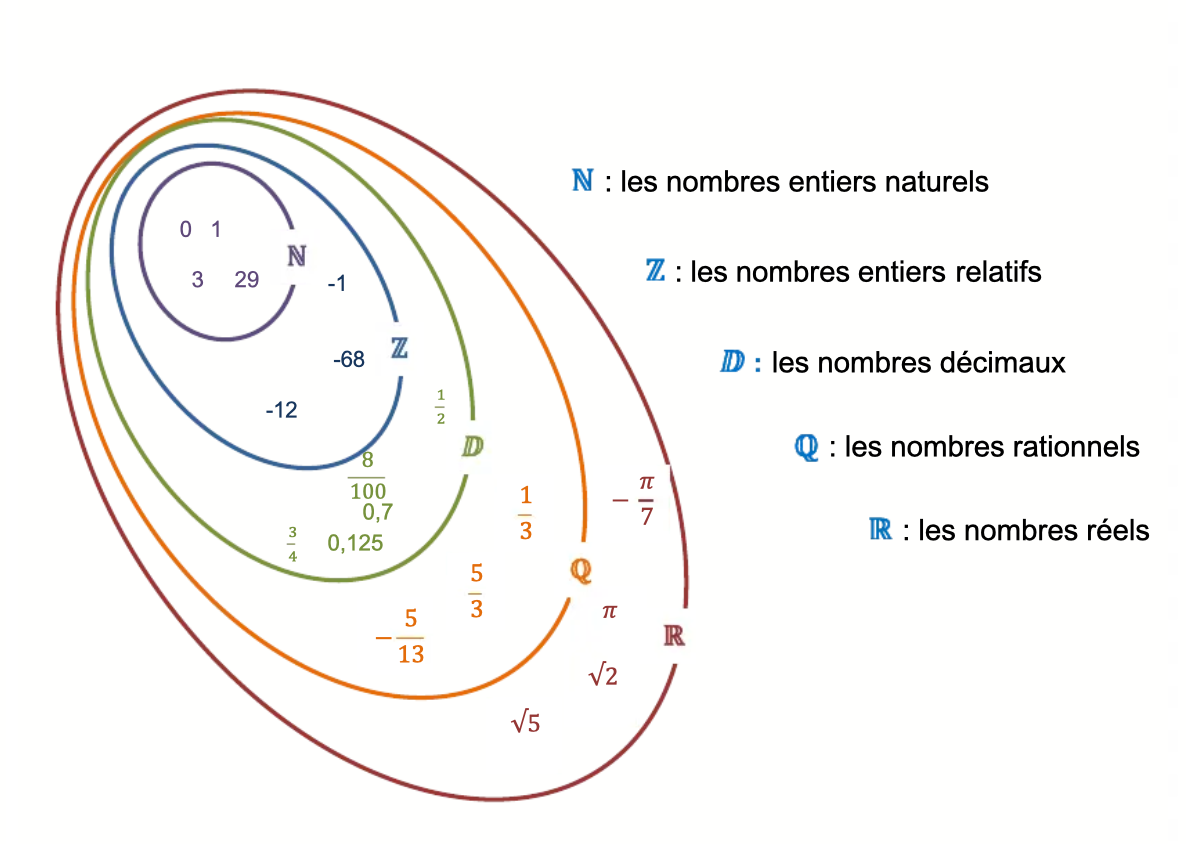
Tous les nombres de l'ensemble des entiers naturels \( \mathbb{N} \) (nombres entiers positifs) appartiennent à l'ensemble des entiers relatifs \( \mathbb{Z} \).
01. Ensemble IN et notion d'arithmétique
| Site: | seedocx - Education |
| Cours: | 01. Ensemble IN et notion d'arithmétique |
| Livre: | 01. Ensemble IN et notion d'arithmétique |
| Imprimé par: | Visiteur anonyme |
| Date: | mercredi 17 juin 2026, 09:01 |
Description
ℕ ⊂ ℤ ⊂ 𝔻 ⊂ ℚ ⊂ ℝ
Tous les nombres de l'ensemble des entiers naturels \( \mathbb{N} \) (nombres entiers positifs) appartiennent à l'ensemble des entiers relatifs \( \mathbb{Z} \).
Donc \( 5 \in \mathbb{Z} \), \( 5 \in \mathbb{D} \), \( 5 \in \mathbb{Q} \), \( 5 \in \mathbb{R} \)
Donc \( -3 \in \mathbb{D} \), \( -3 \in \mathbb{Q} \), \( -3 \in \mathbb{R} \)
Mais \( -3 \notin \mathbb{N} \)
Donc \( 0,5 \in \mathbb{Q} \), \( 0,5 \in \mathbb{R} \)
Mais \( 0,5 \notin \mathbb{Z} \), \( 0,5 \notin \mathbb{N} \)
Donc \( \frac{1}{3} \in \mathbb{R} \)
Mais \( \frac{1}{3} \notin \mathbb{D} \), \( \frac{1}{3} \notin \mathbb{Z} \), \( \frac{1}{3} \notin \mathbb{N} \)
Mais \( \pi \notin \mathbb{Q} \), \( \pi \notin \mathbb{D} \), \( \pi \notin \mathbb{Z} \), \( \pi \notin \mathbb{N} \)
Ensemble
Notation
Exemples
Naturels
\( \mathbb{N} \)
0, 1, 2, 3, 4, ...
Relatifs
\( \mathbb{Z} \)
..., -3, -2, -1, 0, 1, 2, 3, ...
Décimaux
\( \mathbb{D} \)
0,5 ; -1,25 ; 3,14 ; ...
Rationnels
\( \mathbb{Q} \)
\( \frac{1}{3} \) ; \( \frac{2}{7} \) ; \( -\frac{5}{2} \)
Réels
\( \mathbb{R} \)
π, √2, √5, tous les précédents
1. 📚 Exercices – Ensembles de nombres
Indiquer, dans chacun des cas, si le nombre appartient ou pas à chacun des ensembles proposés en rajoutant dans chaque case : ✓ (appartient) ou ✗ (n'appartient pas).
| Nombre | ℕ | ℤ | 𝔻 | ℚ | ℝ |
|---|---|---|---|---|---|
| 3 | |||||
| 18/3 | |||||
| 2 × 10⁻² | |||||
| 22/5 | |||||
| 28/34 | |||||
| 5/6 | |||||
| π/5 | |||||
| √1,44 | |||||
| -√64 |
Indiquer si les affirmations suivantes sont vraies ou fausses.
| Nombre | ℕ | ℤ | 𝔻 | ℚ | ℝ |
|---|---|---|---|---|---|
| 3 | ✓ | ✓ | ✓ | ✓ | ✓ |
| 18/3 = 6 | ✓ | ✓ | ✓ | ✓ | ✓ |
| 2 × 10⁻² = 0,02 | ✗ | ✗ | ✓ | ✓ | ✓ |
| 22/5 = 4,4 | ✗ | ✗ | ✓ | ✓ | ✓ |
| 28/34 = 14/17 | ✗ | ✗ | ✗ | ✓ | ✓ |
| 5/6 | ✗ | ✗ | ✗ | ✓ | ✓ |
| π/5 | ✗ | ✗ | ✗ | ✗ | ✓ |
| √1,44 = 1,2 | ✗ | ✗ | ✓ | ✓ | ✓ |
| -√64 = -8 | ✗ | ✓ | ✓ | ✓ | ✓ |
2. 📚 Exercices corrigés
Énoncé : \( A = \sqrt{7} - \sqrt{33} - \sqrt{7} + \sqrt{33} \) et \( B = \sqrt{\frac{3 - \sqrt{5}}{2}} - \sqrt{\frac{3 + \sqrt{3}}{2}} \).
Énoncé : Calculer \( B = \frac{1}{\sqrt{1 + \sqrt{2}}} + \frac{1}{\sqrt{2 + \sqrt{3}}} + \frac{1}{\sqrt{3 + \sqrt{4}}} + \cdots + \frac{1}{\sqrt{99 + \sqrt{100}}} \).
Énoncé : \( n \) est un entier naturel non nul.
Énoncé : Développement et simplification.
Énoncé : \( X = \sqrt{\frac{12 - \sqrt{23}}{2}} + \sqrt{\frac{12 + \sqrt{23}}{2}} \). Montrer que \( X = \sqrt{\frac{13}{2}} \).
3. 📚 Exercices corrigés
Compléter avec ∈ ou ∉ :
| \(0 \ldots \mathbb{Z}^*\) | \(0 \notin \mathbb{Z}^*\) (car \(\mathbb{Z}^*\) exclut 0) |
| \(\sqrt{97} \ldots \mathbb{R}^-\) | \(\sqrt{97} \notin \mathbb{R}^-\) (car \(\sqrt{97} > 0\)) |
| \(\frac{1}{12} \ldots \mathbb{D}\) | \(\frac{1}{12} \in \mathbb{D}\) (car \(1/12 = 0,08333...\) décimal) |
| \(\frac{2}{3} \ldots \mathbb{Q}\) | \(\frac{2}{3} \in \mathbb{Q}\) (rationnel) |
| \(4,1 \ldots \mathbb{Z}\) | \(4,1 \notin \mathbb{Z}\) (n'est pas entier) |
| \(2 \ldots \mathbb{N}\) | \(2 \in \mathbb{N}\) |
| \(-301 \ldots \mathbb{Q}^+\) | \(-301 \notin \mathbb{Q}^+\) (négatif) |
| \(433 \ldots \mathbb{Z}^*\) | \(433 \in \mathbb{Z}^*\) |
| \(0 \ldots \mathbb{N}\) | \(0 \in \mathbb{N}\) |
| \(5,33 \ldots \mathbb{Q}\) | \(5,33 = \frac{533}{100} \in \mathbb{Q}\) |
| \(5,33 \ldots \mathbb{D}\) | \(5,33 \in \mathbb{D}\) (décimal) |
| \(\frac{17}{2} \ldots \mathbb{D}^+\) | \(\frac{17}{2} = 8,5 \in \mathbb{D}^+\) |
| \(\sqrt{7} \ldots \mathbb{R}^-\) | \(\sqrt{7} \notin \mathbb{R}^-\) (positif) |
| \(\frac{n(n+1)}{2} \ldots \mathbb{N}\) | \(\frac{n(n+1)}{2} \in \mathbb{N}\) (somme des n premiers entiers) |
| \(\sqrt{16} + 2\sqrt{9} \ldots \mathbb{Q}\) | \(4 + 2 \times 3 = 10 \in \mathbb{Q}\) |
| \(\mathbb{R}^- \ldots \mathbb{R}^+\) | \(\mathbb{R}^- \not\subset \mathbb{R}^+\) |
| \(\{0,2,3\} \ldots \mathbb{Z}\) | \(\{0,2,3\} \subset \mathbb{Z}\) |
| \(\{-1\} \ldots \mathbb{Z}^+\) | \(\{-1\} \not\subset \mathbb{Z}^+\) |
| \(\{1,3\} \ldots \mathbb{Z}\) | \(\{1,3\} \subset \mathbb{Z}\) |
| \(\mathbb{N} \ldots \mathbb{Q}^-\) | \(\mathbb{N} \not\subset \mathbb{Q}^-\) (les naturels sont positifs) |
| \(\mathbb{N} \ldots \mathbb{R}\) | \(\mathbb{N} \subset \mathbb{R}\) |
| \(\mathbb{N} \ldots \mathbb{Z}\) | \(\mathbb{N} \subset \mathbb{Z}\) |
| \(\mathbb{N} \ldots \mathbb{D}^+\) | \(\mathbb{N} \subset \mathbb{D}^+\) |
| \(\mathbb{R}^- \ldots \mathbb{Z}\) | \(\mathbb{R}^- \not\subset \mathbb{Z}\) |
| \(\mathbb{N} \ldots \mathbb{Z}^+\) | \(\mathbb{N} \subset \mathbb{Z}^+\) |
| \(\mathbb{N}^* \ldots \mathbb{Z}^*\) | \(\mathbb{N}^* \subset \mathbb{Z}^*\) |
| \(\{-1\} \cap \mathbb{Z}^+\) | \(\emptyset\) (aucun élément commun) |
| \(\{1,3\} \cap \mathbb{Z}\) | \(\{1,3\}\) |
| \(\mathbb{N} \cap \mathbb{Q}^-\) | \(\{0\}\) |
| \(\mathbb{N} \cap \mathbb{R}\) | \(\mathbb{N}\) |
| \(\mathbb{N} \cap \mathbb{Z}\) | \(\mathbb{N}\) |
| \(\mathbb{N} \cap \mathbb{R}^*\) | \(\mathbb{N}^*\) |
| \(\mathbb{D} \cap \mathbb{Q}\) | \(\mathbb{D}\) |
| \(\mathbb{Z}^- \cap \mathbb{Z}^*\) | \(\mathbb{Z}^- \setminus \{0\}\) |
| \(\mathbb{R} \cap \mathbb{R}^+\) | \(\mathbb{R}^+\) |
| \(\{0,2,3\} \cap \mathbb{Z}\) | \(\{0,2,3\}\) |
| \(\mathbb{N} \cap \mathbb{D}^+\) | \(\mathbb{N}\) |
| \(\mathbb{R} \cap \mathbb{Z}\) | \(\mathbb{Z}\) |
| \(\mathbb{N} \cap \mathbb{Z}^+\) | \(\mathbb{N}\) |
| \(\mathbb{N}^* \cap \mathbb{Z}^*\) | \(\mathbb{N}^*\) |
| \(\{-1\} \cup \{1,3,4\}\) | \(\{-1,1,3,4\}\) |
| \(\{1,3\} \cup \mathbb{Z}\) | \(\mathbb{Z}\) |
| \(\mathbb{N} \cup \mathbb{Q}^*\) | \(\mathbb{Q}\) |
| \(\mathbb{N} \cup \mathbb{R}\) | \(\mathbb{R}\) |
| \(\mathbb{N} \cup \mathbb{R}^+\) | \(\mathbb{R}^+\) |
| \(\{0,2,3\} \cup \mathbb{Z}\) | \(\mathbb{Z}\) |
4. 📚 Exercices – Calcul littéral et puissances
Soient a et b deux entiers naturels, on pose \( Z = a^2 + 2ab + b^2 + a + b + 1 \).
Soient \( x, y \) et \( z \) des réels non nuls. Simplifier les expressions suivantes :
Développer les expressions suivantes :
Factoriser les expressions suivantes :
a est un nombre réel non nul, on pose : \( A = a + \frac{1}{a} \).
Soient a et b deux nombres réels tels que :
a, b et c des nombres réels tels que : \( abc = 1 \).
Donner l'écriture scientifique de chacun des nombres suivants :
Soient a et b deux nombres réels non nuls. Calculer
a, b et c des nombres réels non nuls tels que : \( ab + bc + ca = 0 \).
-------------------------
Énoncé : \( Z = a^2 + 2ab + b^2 + a + b + 1 \)
Si on pose \( a + b = k \), alors \( Z = k^2 + k + 1 \).
On peut aussi écrire : \( Z = (a+b)^2 + (a+b) + 1 \).
Énoncé : Simplifier les expressions.
Énoncé : Développer les expressions.
Énoncé : Factoriser les expressions.
Énoncé : \( A = a + \frac{1}{a} \). Calculer en fonction de \( A \).
Énoncé : \( 2^a \times 3^b \times 5^c = 648000 \)
Énoncé : \( 2(a^2 + b^2) = 5ab \). Calculer \( A = \frac{a - b}{a + b} \).
Cas 1 : \( 2a - b = 0 \Rightarrow b = 2a \). Alors
Cas 2 : \( a - 2b = 0 \Rightarrow a = 2b \). Alors
Énoncé : \( abc = 1 \). Montrer que :
On a \( abc = 1 \Rightarrow bc = \frac{1}{a} \) et \( ca = \frac{1}{b} \).
En additionnant, on obtient 1.
Énoncé : Écriture scientifique.
Énoncé : Calculer pour \( a = 10^{-3} \), \( b = -10^{-2} \).
Simplifions d'abord l'expression :
Calculons \( a^2b = (10^{-3})^2 \times (-10^{-2}) = 10^{-6} \times (-10^{-2}) = -10^{-8} \).
Donc \( a^2b - 1 = -10^{-8} - 1 \approx -1 \).
Énoncé : \( ab + bc + ca = 0 \). Calculer \( \frac{b+c}{a} + \frac{c+a}{b} + \frac{a+b}{c} \).
Or \( ab + bc + ca = 0 \Rightarrow \frac{ab+bc+ca}{abc} = 0 \Rightarrow \frac{1}{c} + \frac{1}{a} + \frac{1}{b} = 0 \).
On a \( \frac{b}{a} + \frac{a}{b} = \frac{b^2+a^2}{ab} \) et \( \frac{1}{a} + \frac{1}{b} = \frac{a+b}{ab} \).