Exercices - Tronc commun Sciences BIOF

📌 Ex 1-1 : Compléter par ∈ ou ∉

1) \(5 \; \ldots \; \mathbb{N}\) ; \(5 \; \ldots \; \mathbb{Z}\) ; \(5 \; \ldots \; \mathbb{D}\) ; \(5 \; \ldots \; \mathbb{Q}\) ; \(5 \; \ldots \; \mathbb{R}\)

2) \(-\frac{45}{9} \; \ldots \; \mathbb{N}\) ; \(-\frac{45}{9} \; \ldots \; \mathbb{Z}\) ; \(-\frac{45}{9} \; \ldots \; \mathbb{D}\) ; \(-\frac{45}{9} \; \ldots \; \mathbb{Q}\) ; \(-\frac{45}{9} \; \ldots \; \mathbb{R}\)

3) \(-\frac{7}{8} \; \ldots \; \mathbb{N}\) ; \(-\frac{7}{8} \; \ldots \; \mathbb{Z}\) ; \(-\frac{7}{8} \; \ldots \; \mathbb{D}\) ; \(-\frac{7}{8} \; \ldots \; \mathbb{Q}\) ; \(-\frac{7}{8} \; \ldots \; \mathbb{R}\)

✅ Corrigé

1) \(5 \in \mathbb{N}, \in \mathbb{Z}, \in \mathbb{D}, \in \mathbb{Q}, \in \mathbb{R}\)

2) \(-\frac{45}{9} = -5 \notin \mathbb{N}, \in \mathbb{Z}, \in \mathbb{D}, \in \mathbb{Q}, \in \mathbb{R}\)

3) \(-\frac{7}{8} \notin \mathbb{N}, \notin \mathbb{Z}, \notin \mathbb{D}, \in \mathbb{Q}, \in \mathbb{R}\)
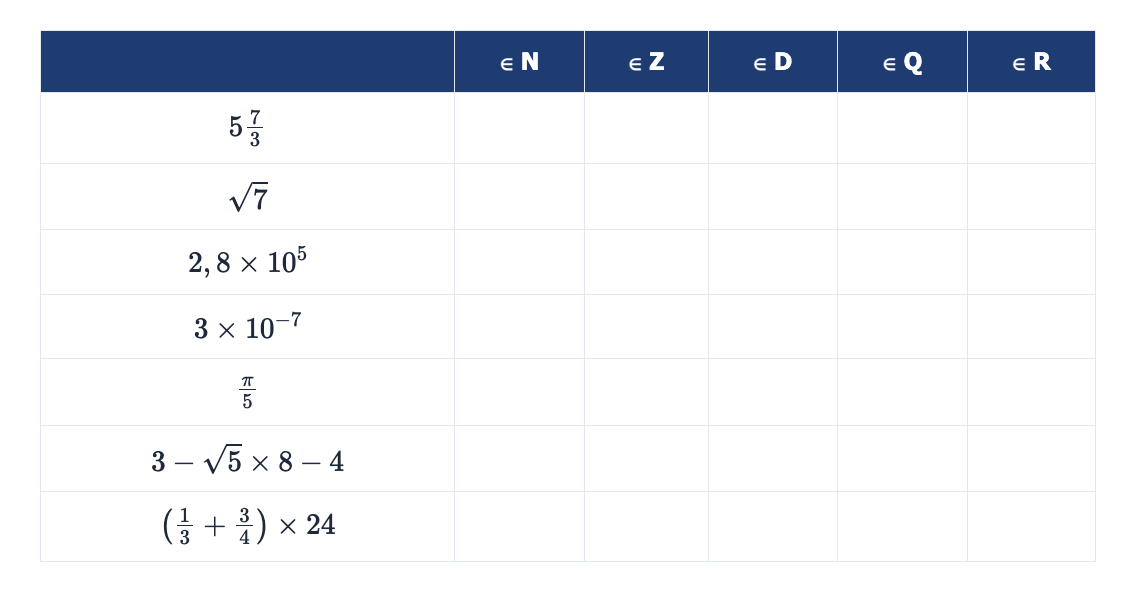

📌 Ex 1-2 : Vrai ou faux
x1

  ∈ N ∈ Z ∈ D ∈ Q ∈ R
\(5\frac{7}{3}\)          
\(\sqrt{7}\)          
\(2,8 \times 10^5\)          
\(3 \times 10^{-7}\)          
\(\frac{\pi}{5}\)          
\(3 - \sqrt{5} \times 8 - 4\)          
\(\left(\frac{1}{3}+\frac{3}{4}\right) \times 24\)          
✅ Corrigé

\(5\frac{7}{3} = \frac{22}{3}\) : ❌ N, ❌ Z, ❌ D, ✅ Q, ✅ R

\(\sqrt{7}\) : ❌ N, ❌ Z, ❌ D, ❌ Q, ✅ R

\(2,8 \times 10^5 = 280000\) : ✅ N, ✅ Z, ✅ D, ✅ Q, ✅ R

\(3 \times 10^{-7} = 0,0000003\) : ❌ N, ❌ Z, ✅ D, ✅ Q, ✅ R

\(\frac{\pi}{5}\) : ❌ N, ❌ Z, ❌ D, ❌ Q, ✅ R

\(\left(\frac{1}{3}+\frac{3}{4}\right) \times 24 = 26\) : ✅ N, ✅ Z, ✅ D, ✅ Q, ✅ R


📌 Ex 1-3 : Nombres décimaux

Entourer les nombres rationnels qui appartiennent à \(\mathbb{D}\) :

\[ \frac{5}{2},\; \frac{10}{3},\; \frac{45}{26},\; \frac{47}{25},\; \frac{12}{20},\; \frac{28}{5},\; \frac{3}{8} \]
✅ Corrigé

\(\frac{5}{2}=2,5 \in \mathbb{D}\); \(\frac{47}{25}=1,88 \in \mathbb{D}\); \(\frac{12}{20}=0,6 \in \mathbb{D}\); \(\frac{28}{5}=5,6 \in \mathbb{D}\); \(\frac{3}{8}=0,375 \in \mathbb{D}\)


📌 Ex 1-4 : Nombres rationnels

Entourer les réels qui appartiennent à \(\mathbb{Q}\) :

\[ 8^{\frac{456}{7}},\; \frac{\sqrt{3}}{7},\; \frac{\sqrt{7}+2}{7},\; \frac{5\pi}{1000},\; \frac{\pi}{1000},\; \frac{\sqrt{144}}{121},\; \frac{3}{(\sqrt{2}-\sqrt{3})^2},\; 7,5 \]
✅ Corrigé

\(\frac{\sqrt{144}}{121} = \frac{12}{121} \in \mathbb{Q}\); \(7,5 \in \mathbb{Q}\)


📌 Ex 1-5 : Développement décimal périodique

Soit \(y = 0,00723723723\ldots\)

a) Compléter : \(1000y = 7,237237\ldots = 7,23 + y\)

b) En déduire l'écriture fractionnaire de \(4,24723723723\ldots\)

✅ Corrigé

\(1000y - y = 7,23\)\(999y = \frac{723}{100}\)\(y = \frac{723}{99900} = \frac{241}{33300}\)

\(4,247237237\ldots = 4 + \frac{247}{1000} + y = \frac{4247237}{1000000}\)


📌 Ex 1-6 : \(\sqrt{2}\) n'est pas rationnel

Supposons \(\sqrt{2} = \frac{p}{q}\) avec \(\frac{p}{q}\) irréductible.

Alors \(p^2 = 2q^2\)\(p^2\) est pair ⇒ \(p\) est pair ⇒ \(p = 2n\)

\((2n)^2 = 2q^2\)\(4n^2 = 2q^2\)\(q^2 = 2n^2\)\(q\) est pair

Contradiction car \(\frac{p}{q}\) irréductible. Donc \(\sqrt{2} \notin \mathbb{Q}\).

✅ Corrigé

\(\sqrt{2}\) n'est pas un nombre rationnel.


📌 Ex 1-7 : \(\frac{1}{3}\) n'est pas un décimal

Supposons que \(\frac{1}{3} = \frac{a}{10^n}\) avec \(a \in \mathbb{Z}\).

Alors \(10^n = 3a\)\(3\) divise \(10^n\) impossible car \(10^n = 2^n \times 5^n\).

Donc \(\frac{1}{3} \notin \mathbb{D}\).

✅ Corrigé

\(\frac{1}{3}\) n'est pas un nombre décimal car son développement décimal est périodique.