متطلبات الإكمال
Exercices : Barycentre, Parallélogramme, Centre de gravité
Barycentre ⭐⭐ Moyen
📌 Énoncé
Soient \(A\) et \(B\) deux points tels que \(AB = 5 \, \text{cm}\).
Soit \(M\) le point défini par :
\[ -5\overrightarrow{MA} + 3\overrightarrow{MB} = \vec{0} \]
Déterminer le vecteur \(\overrightarrow{AM}\) en fonction du vecteur \(\overrightarrow{AB}\) et construire le point \(M\).
✅ Corrigé
On a \(-5\overrightarrow{MA} + 3\overrightarrow{MB} = \vec{0}\)
\[ -5\overrightarrow{MA} + 3(\overrightarrow{MA} + \overrightarrow{AB}) = \vec{0} \]
\[ -5\overrightarrow{MA} + 3\overrightarrow{MA} + 3\overrightarrow{AB} = \vec{0} \]
\[ -2\overrightarrow{MA} + 3\overrightarrow{AB} = \vec{0} \]
\[ 2\overrightarrow{AM} + 3\overrightarrow{AB} = \vec{0} \]
\[ \overrightarrow{AM} = -\frac{3}{2}\overrightarrow{AB} \]
Donc \(M\) est sur la droite \((AB)\) tel que \(AM = \frac{3}{2}AB = 7,5\,cm\) et \(M\) est du côté opposé à \(B\) par rapport à \(A\).
Parallélogramme ⭐⭐⭐ Moyen+
📌 Énoncé
Soit \(ABCD\) un parallélogramme de centre \(I\).
1) Construire le point \(M\) tel que \(\overrightarrow{IM} = \overrightarrow{IA} + \overrightarrow{ID}\) et le point \(N\) tel que \(\overrightarrow{IN} = \overrightarrow{IB} + \overrightarrow{IC}\).
2) Démontrer que \(\overrightarrow{IM} + \overrightarrow{IN} = \vec{0}\). Que peut-on en déduire ?
3) Justifier les deux égalités suivantes : \(\overrightarrow{BN} = \overrightarrow{IC}\) et \(\overrightarrow{IC} = \overrightarrow{AI}\). En déduire la nature du quadrilatère \(ABNI\).
✅ Corrigé
1) Construction sur figure.
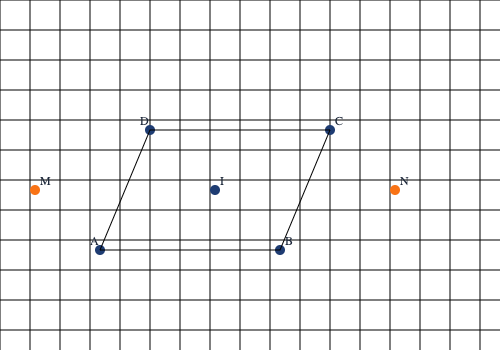
2) \(\overrightarrow{IM} = \overrightarrow{IA} + \overrightarrow{ID}\) et \(\overrightarrow{IN} = \overrightarrow{IB} + \overrightarrow{IC}\)
En additionnant : \(\overrightarrow{IM} + \overrightarrow{IN} = \overrightarrow{IA} + \overrightarrow{IB} + \overrightarrow{IC} + \overrightarrow{ID}\)
Comme \(I\) est le centre du parallélogramme, \(\overrightarrow{IA} + \overrightarrow{IC} = \vec{0}\) et \(\overrightarrow{IB} + \overrightarrow{ID} = \vec{0}\)
\[ \overrightarrow{IM} + \overrightarrow{IN} = \vec{0} \]
Donc \(I\) est le milieu de \([MN]\).
3) \(\overrightarrow{BN} = \overrightarrow{BI} + \overrightarrow{IN} = \overrightarrow{ID} + \overrightarrow{IB} + \overrightarrow{IC} = \overrightarrow{IC}\)
\(\overrightarrow{IC} = \overrightarrow{AI}\) car \(I\) centre du parallélogramme.
Donc \(ABNI\) est un parallélogramme.
Parallélisme ⭐⭐ Moyen
📌 Énoncé
Soit \(ABC\) un triangle.
1) Placer le point \(E\) tel que \(\overrightarrow{AE} = \frac{1}{3}\overrightarrow{AB}\).
2) Placer le point \(F\) tel que \(\overrightarrow{AF} = 3\overrightarrow{AC}\).
3) Démontrer que les droites \((CE)\) et \((FB)\) sont parallèles.
✅ Corrigé
1) et 2) Construction sur figure.
3) Exprimons \(\overrightarrow{CE}\) et \(\overrightarrow{FB}\) :
\[ \overrightarrow{CE} = \overrightarrow{CA} + \overrightarrow{AE} = -\overrightarrow{AC} + \frac{1}{3}\overrightarrow{AB} \]
\[ \overrightarrow{FB} = \overrightarrow{FA} + \overrightarrow{AB} = -3\overrightarrow{AC} + \overrightarrow{AB} \]
On remarque que \(\overrightarrow{FB} = 3\overrightarrow{CE}\), donc les vecteurs sont colinéaires.
Par conséquent, \((CE) \parallel (FB)\).
Centre de gravité ⭐⭐⭐ Difficile
📌 Énoncé
Soit \(PQR\) un triangle de centre de gravité \(G\).
Soient les points \(I, J\) et \(K\) tels que :
\[ \overrightarrow{GI} = -3\overrightarrow{GP}, \quad \overrightarrow{GJ} = -3\overrightarrow{GQ}, \quad \overrightarrow{GK} = -3\overrightarrow{GR} \]
1) Faire une figure.
2) Démontrer que \(G\) est le centre de gravité du triangle \(IJK\).
✅ Corrigé
1) Construction sur figure.
2) On a \(\overrightarrow{GI} = -3\overrightarrow{GP}\), donc \(\overrightarrow{GP} = -\frac{1}{3}\overrightarrow{GI}\)
De même, \(\overrightarrow{GQ} = -\frac{1}{3}\overrightarrow{GJ}\) et \(\overrightarrow{GR} = -\frac{1}{3}\overrightarrow{GK}\)
Comme \(G\) est le centre de gravité de \(PQR\) :
\[ \overrightarrow{GP} + \overrightarrow{GQ} + \overrightarrow{GR} = \vec{0} \]
En remplaçant :
\[ -\frac{1}{3}\overrightarrow{GI} - \frac{1}{3}\overrightarrow{GJ} - \frac{1}{3}\overrightarrow{GK} = \vec{0} \]
\[ \overrightarrow{GI} + \overrightarrow{GJ} + \overrightarrow{GK} = \vec{0} \]
Donc \(G\) est le centre de gravité du triangle \(IJK\).
آخر تعديل: الأربعاء، 10 يونيو 2026، 1:14 PM